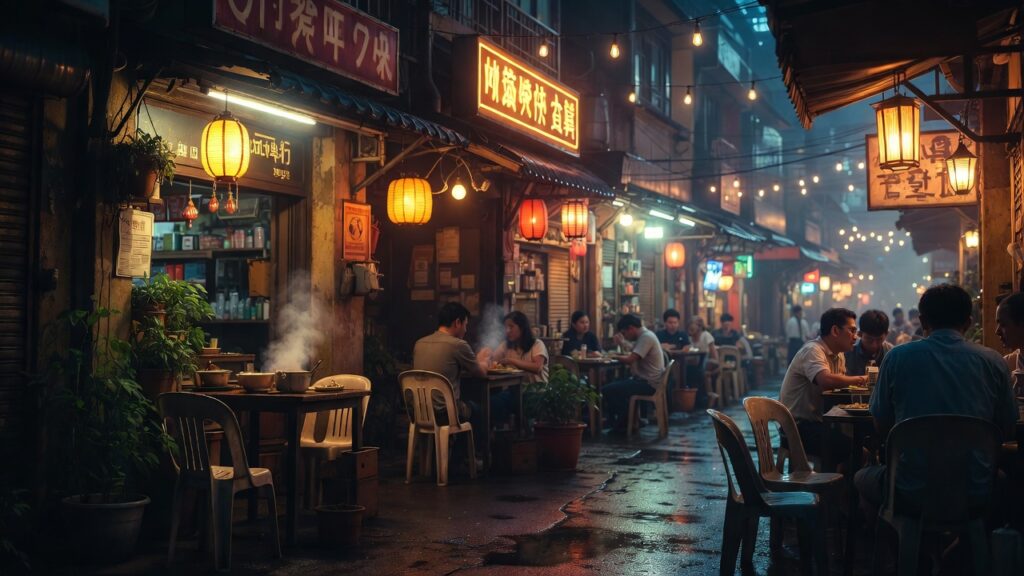

I used to have this silly routine that now feels almost ridiculous when I think about it. Every Friday night, after a long day staring at my laptop and chasing deadlines, I’d walk to a small nasi uduk warung in the alley behind my old kos. The place only had five faded blue plastic tables, a flickering yellow neon sign, and a ceiling fan that sounded like a broken washing machine. But strangely, I kept going back. Not because the nasi uduk was the best in Jakarta—plenty of places are better—but because the moment I stepped in, Pak Dedi would just nod and say, “The usual, Mas? Nasi uduk ayam goreng, extra sambal ijo.” I never had to order it out loud every week, but he remembered. I’d sit in the same corner, at the table that wobbles if you shift the chair, and it felt like coming home to a place that didn’t need any explanation.
The Quiet Power of Repetition
Neighborhood spots have this power that’s hard to explain if you only look from the outside. They don’t just sell food; they spin a kind of personal vibe you won’t get at big restaurants or trendy cafes. You walk in, and you immediately feel “this place lets me be me.” No need to pose, no need for long reviews, no need to tell friends “this is a hidden gem, guys.” You just sit, eat, leave—and you leave carrying a slightly lighter feeling than when you arrived.
I used to think it was pure nostalgia talking. But after moving to a new area and trying all the “modern” places—minimalist cafes with perfect lighting, curated playlists, tablet ordering—I missed that old warung. Everything there was efficient: order fast, food arrives fast, bill via QR. I left full, but empty. No echo of “see you next week.” No quiet nod from the staff. Just done. Cold, like an ATM transaction—quick, accurate, but hollow.
What makes these small places spin such a personal feel? I think it’s the repetition that isn’t forced. The taste is almost the same every time—it never changes drastically. The wobbly table stays wobbly. The smell of frying oil mixed with cigarette smoke from the next table stays the same. The fan keeps its annoying noise. Nothing groundbreaking, but everything predictable. In a city where everything shifts every month—prices go up, menus change, promos disappear—predictability becomes a small jackpot. You know what you’re getting, and that knowledge makes you feel safe.
Human Moments Over Scripts
Then there’s the human layer that makes it all different. The owner or the same waiter is there almost every day. No scripted “welcome back, sir!” like in chain restaurants. Just a casual “Haven’t seen you in a while, Mas?” or a quick glance and the plate sliding across. That small acknowledgment builds trust slowly. You don’t have to explain yourself. You don’t have to perform. You just exist, and the place lets you exist.
I’ve heard friends in Manila say the same about their street-side warung near their apartment. Friends in Bangkok have stories about the mie ayam stall where the vendor remembers you like your broth thick. Even in New York, people have their corner diner that feels the same. It’s not always the best food in the city, but it becomes a low-stakes anchor. You can sit alone without feeling weird, or bring a friend and talk for hours without anyone hovering to clear the table. The quirks—slow service because the cook is chatting with a regular, the handwritten “cash only” sign, the owner’s kid helping on weekends—create stories. And stories create belonging.
Imperfect, But Alive
But don’t get me wrong—these places aren’t perfect. Service can drag when the waitress is on the phone. The bathroom sometimes makes you hesitate. Wi-Fi? It either doesn’t exist or is painfully slow. But those imperfections are exactly what make them feel alive. They’re not optimized for maximum profit. They’re optimized for people who need a break from optimization.
Compare that to chains: same lighting, same menu, same playlist everywhere. Safe, but sterile. Neighborhood spots still have room for human error—the radio playing dangdut at low volume, the plate that’s slightly chipped but spotless, the owner closing early because “my kid’s birthday today.” It’s not efficient, but it’s real.
Why We Keep Returning
I’ve started to believe that the best urban comfort doesn’t come from luxury. It comes from familiarity that spins quietly in the background. You return not because you have to, but because it feels right. And when a place makes you feel right without trying, it becomes more than a restaurant. It becomes a small piece of home in a city that rarely lets you slow down.
But I also wonder—is this just me overthinking? Do other people have their own warung or small kedai that acts as their anchor? I asked some friends, and almost everyone had a similar story. Someone has a warteg near the office where the staff knows you like sayur lodeh without eggplant. Someone else has a gerobak kopi susu where the lady always adds less sugar without you asking. It’s small, but it hits. It makes you come back tomorrow, the day after, until it becomes part of your day.
In an era where everything can be ordered online and delivered in 30 minutes, a place that requires you to show up, sit down, talk, and leave feeling a bit more whole—that’s rare. That’s an anchor. That’s a reminder that eating is never just about filling your stomach. Sometimes eating is about feeling seen, remembered, accepted—without having to explain who you are.
Maybe I’m going too far with this. Maybe it’s just me being dramatic. But every time I pass that alley again and see the yellow neon from afar, I think: should I stop by this Friday? Maybe yes. Maybe just sit for a bit, order the usual nasi uduk, and leave with a slightly lighter feeling. And that’s enough for me.
If you’ve ever wondered why some meals stick in your memory long after the taste is gone, check out the next piece in this series: Eating Is Never Just About Food. It dives into how flavor, place, and moment weave together in ways we don’t always notice.
For anyone reading from another city, there’s a good article on Eater about how urban food culture in big cities is slowly rediscovering the value of soulful local spots—worth a read if you like peeling back these kinds of layers.

